Saturday, January 29, 2011

Boyd's Tower

   
Ben Boyd came to Australia in 1842 to make his fortune, and he did—until his financial ruin, when he took off to California at the time of the gold rush. He ran a whaling business in Eden (“A Natural Paradise,” as it describes itself) and he had a big sheep station inland. He exported his wool through Eden, which he helped to develop as a port. It has an extensive deepwater harbour. His name is now memorialized in the Ben Boyd National Park, which covers many miles of coastline to the north and south of Eden.
         On a headland in the southern section of the Park is Boyd's Tower, a tall square building that you would guess is a lighthouse. It is built with large blocks of stone, and a lot of superfluous stone still lies around the tower. It was used by Ben Boyd’s men as a lookout for whales. They kept watch from the top of the tower and fired a gun when whales were spotted. The shore-based whalers—six oarsmen and a harpooner, mostly aborigines---rushed to their boats and rowed frantically out to intercept the whales.
Here are two views of the tower, which also provide a sense of the coastline.
       Off-shore whaling from Eden began in 1828—started by one Thomas Raine. Another off-shore whaling enterprise was run by the Davidson family for many generations, and that continued until 1929.
       The rocks on the coastline vary from red to green and in-between. Here are two pockmarked rocks of different colours.


Wildlife is abundant in the Park. “There’s someone coming,” said Joan as we hiked through the bush, and then “Oh, it’s a kangaroo.” 


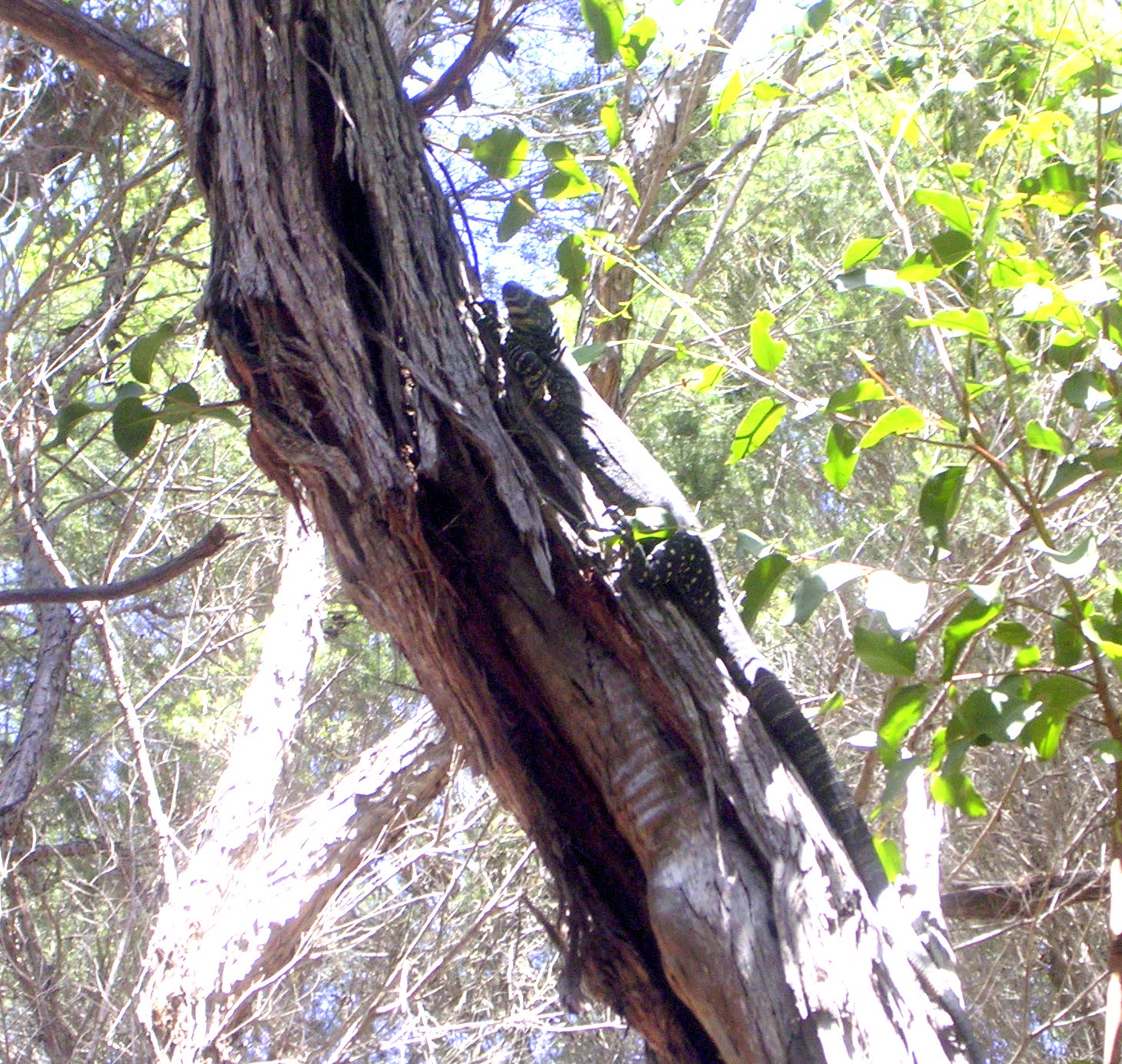
There are a lot of large lizards—big, Godzilla types. One we disturbed (a smaller one than others we saw) ran up a tree, and froze, relying on his camouflage for protection.
The photos show you how that camouflage works. Look carefully and you can make him or her out.
 A little more about Eden in the next posting. In the meantime, we need to watch the final of the Women in the Australian Open Tennis Championship.


Friday, January 28, 2011

The Road to Eden


The road from Paynesville to Eden is about 220 kms. And we have to admit that it was rather boring. Although the road—Princes Highway--runs parallel to the coast, we got only rare glimpses of the sea, and a large part of the trip was through what would be called ‘bush’ here. We would call it woodland. And the road was winding and rolling with some steep up-hills and down-hills. It was only two lanes, but there were stretches of passing lanes every few kilometers.
         We did make an excursion off the main road to a headland called Cape Conran, where we took a few cliché pictures of sandbars, waves breaking on rocks—you know the sort of thing: when you don’t worry about wasting film, it is almost a reflex action to take these pictures. You can skip them.


But there were some oddities. These bright purple berries, for example.


And these strange rock formations.

We stopped and had our lunch--sandwiches (made by Joan the night before) in a small park in a place (hardly a town) called Cann River, and it occurred to me how typical the little park was: we have seen dozens and dozens like it. The childrens’ playground was shaded by the obligatory canvas canopies to keep the sun off the kids.


There were the shelters with one or more picnic tables. This one only had one. And under the shelter—the electric barbeque.


No charge: use the electricity to do your grilling. This shelter only had one, but we have seen shelters with two and more. The Australians love to picnic: and when they picnic, they love to barbeque. We have seen large family groups crowded under these shelters with two barbeques in operation. Possibly the provision of electric barbeques is to discourage the use of charcoal fires--given the usual concern about bush fires.

And this was a refinement we had not seen before--somewhere to do the dishes.


On into Eden and our beach-side cottage for the next two nights. As we turned off the highway, there was the sound of –what?—wind-chimes, bells? Was it the damn car? We stopped, but the chiming went on. Must be wind-chimes somewhere. But when we asked the motel manager what the bells were, he explained that it was the bell-bird that made them. They continue to chime away as I sit at the computer. Go into You Tube, and you can hear them: search bell bird.
         Eden was the centre of a thriving off-shore whaling industry, with the boats crewed mainly by aboriginals. Now it aims to attract the tourists with whale watching—subject to strict rules as to how close to the whales you are allowed to get. The whales migrate up from the Antarctic in the spring and there are none in evidence at this time of the year.


 Eden has some rocky headlands and one long surf beach.

         It also seems to have strange liquor laws. I was told in the supermarket that the only place I could buy beer was at the Fishermen’s Club, where I had to sign in as a temporary member before I could buy a six-pack of beer. To get to the Club, I managed inadvertently to drive the wrong way down a one-way street. Joan was displeased, at least until I returned with the beer.


Thursday, January 27, 2011

The Ferry to Koala Land


Paynesville is a boating and sailing centre in the lakes regions, situated between Lake King and Lake Victoria—two huge bodies of water.  It has a ferry to an island called Raymond Island, which is all of 200 yards away. 

    The ferry plies to and fro across this narrow strip of water throughout the day, making the 3 minute trip every quarter of an hour. It carries pedestrians and cyclists free and charges for cars—and the car traffic is quite brisk.


This is the waiting room on the Paynesville side.
This lady with her tricycle was taking her shopping home when we went on the ferry. Difficult to see, but she has a bumper sticker on her trike that says “I (heart) the R.I. Ferry.” For a moment we thought it meant Rhode Island. Note the six-pack of beer in with the groceries.

And this is her cycling off the ferry on the other side.

But unless you live there, the most important reason for anyone to make the trip is to see the koalas, which are apparently concentrated there for unexplained reasons. Although the island is quite small, it features a sign-posted Koala Walk, which wanders through parks and quiet residential streets. It is claimed to be the best place in Victoria to see koalas. And we did see them in the eucalyptus trees, their arms wrapped about a branch while they appear to be napping. They sleep about 18 hours a day, as their diet consists exclusively of eucalyptus leaves, which provide them with a very low level of energy, and they always appear sleepy and lethargic. Difficult to get them to pose.  Difficult even to encourage them to move. But narcolepsy has its charms, as per the following.


No wonder Qantas has appropriated them as a mascot!

Gippsland


To the southeast of Melbourne is the area known as Gippsland, with a coastline of 250 miles of beaches, inlets, and coves.  Gippsland Lakes is the largest inland lake system in Australia, enclosed by the sand dunes and beaches of Ninety Mile Beach--a name that has survived Australia's decimalisation of weights and measures.


Fishing from the town of Lakes Entrance is a major industry.


The small village of Metung offered opportunities for watching pelicans being fed-- and struggling mightily with-- a large helping of squid.

A typical view out over the lakes towards the sand dunes of 90 Mile Beach.


On a long walk on the beach we came across this sea horse washed up by the tide.

Wednesday, January 26, 2011

Wilmot-Valley of Views


      The distance from Cradle Mountain back to Devonport and the ferry is about 80 kms, with only two towns marked on the map: Moina and Wilmot. Moina is not noticeable: gone before you realize you are there. Wilmot holds itself out as something of a tourist attraction—the guide book mentions the famous Cole Brothers General Store (in the family for generations), the Museum and, intriguingly, “a self-guiding tour of unusual mail boxes.” And it also the self-proclaimed heart of 'The Valley of the Views.'
         All this seems to be something of the norm in small Tasmanian and mainland towns—anything to get the passing cars to stop. Railton calls itself ‘The Topiary Capital of Tasmania’ and Sheffield has its murals. And all these small towns have their museums for which they charge you to view a few old artifacts, faded brown photos of local dignitaries, pictures of the floods (and bush fires) of the past, an old plough or road signs, and a press cutting reporting the visit of some obscure member of the royal family—those sorts of thing. A friendly elderly lady is usually in charge.
         Wilmot delivered on its promises. There were super views along the rolling and meandering road.


And the Cole Brothers Store was there, with the added bonus of a mural depicting some of the quirky mail boxes.


 It had the typical small town museum, which promised "a comprehensive range of war memorabilia, local history, antiques, tools, and other interesting artifacts."


And it had its mail boxes, spread out along the main road for miles --except for the first, which was made by the elderly man who filled our car with petrol at Coles Brothers--they did petrol too. “Go up there,” he said, “and see the one I made.”
And as we drove along the main (only) road, they kept appearing:


We arrived in Devonport. It was my birthday. Strange that I was born on the edge of Devonport in England, and here I was in a Devonport on the other side of the world.
One interesting poster caught our eye. An advertisement for an Australia Day (January 26) attraction in the nearby town of Latrobe.
"Fun, food, ferrets and fitness"-- sorry we had to miss that one!  Apparently ferret racing is very popular, and on a news program we also saw cockroach racing.


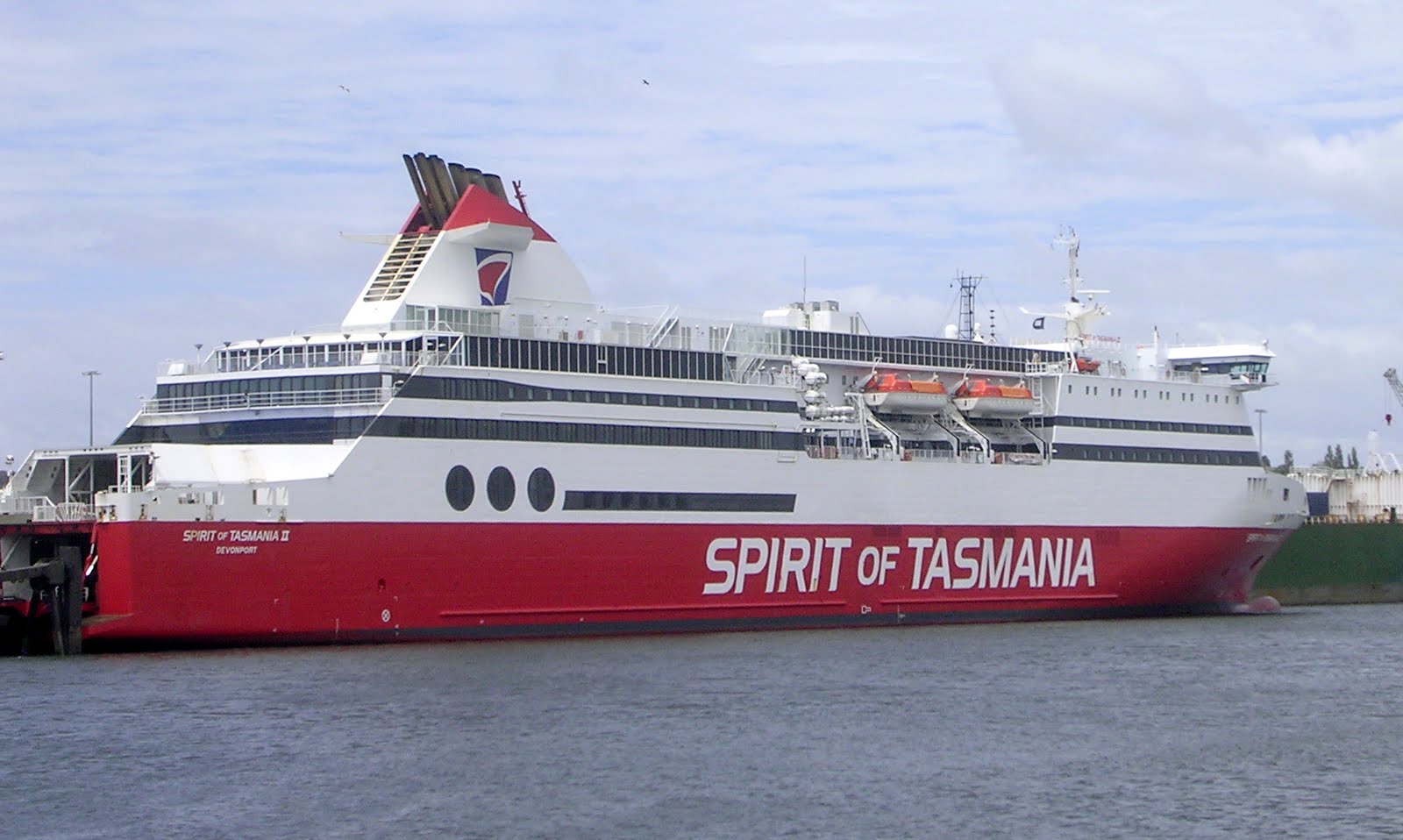
There she was, ready for the trip back across the Bass Strait. We slept soundly through it and emerged into St. Kilda, Melbourne, on a miserable rainy day.
PS: a reminder--click on the pictures to enlarge them. Click on the back button to return to the blog.